World Mobile was built on a simple idea: connectivity should be built differently, owned by the people who power it, shaped by the communities who need it, and designed to return value to them all.
In Pakistan, that vision was brought to life with the Spark AirNode rollouts. Spark AirNodes opened the doors for community-powered connectivity in Pakistan, helped millions of people get online, and proved that a decentralized model can work in one of the fastest-growing economies of the world.
Now, the network is ready to build on that success and decentralize the layers that sit further upstream; layers that receive connectivity and distribute it locally, all while being part of a decentralized, community-powered ecosystem.
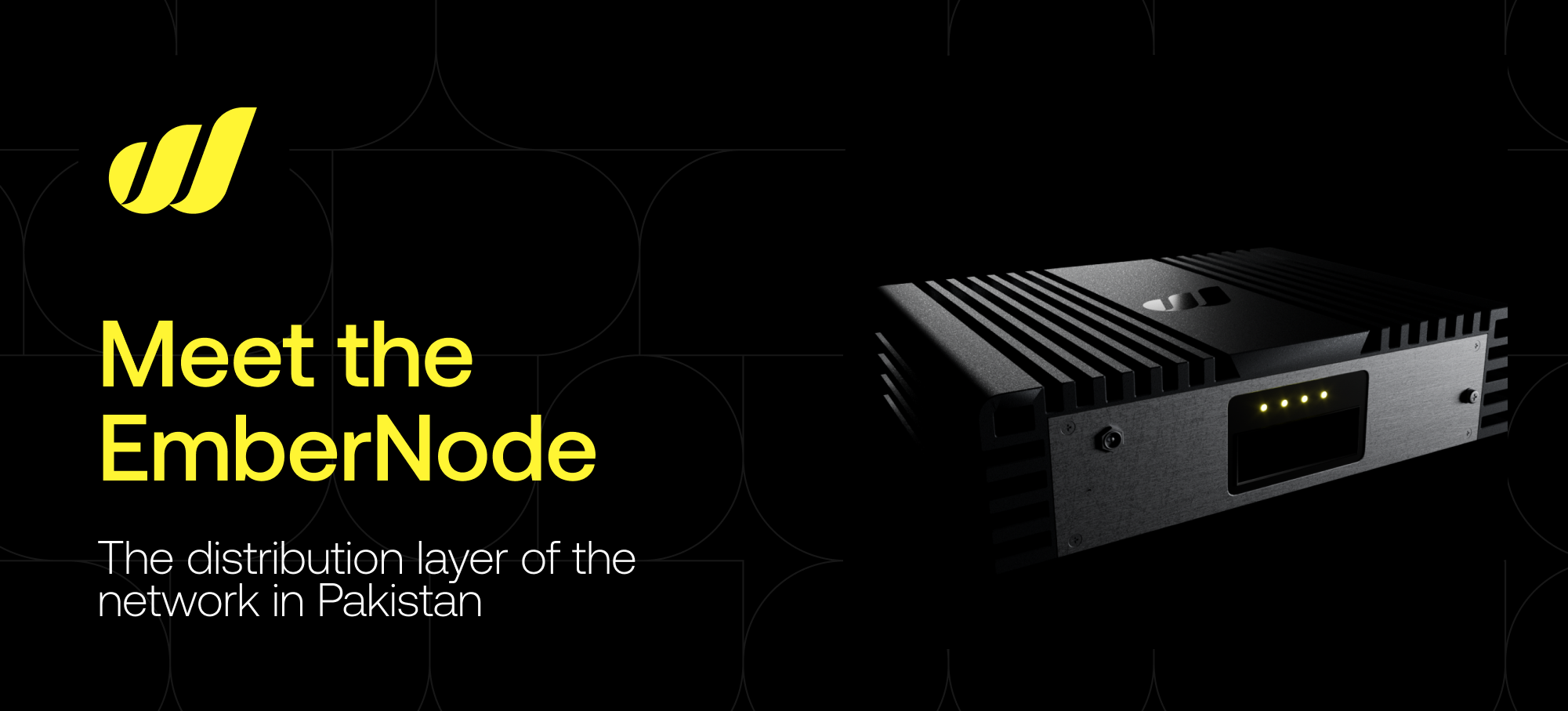
Meet EmberNode: a new World Mobile infrastructure product that opens the distribution layer of the Pakistan network to Operators for the first time.
What is the EmberNode?
The EmberNode is best described as distribution infrastructure.
It is a ruggedized outdoor gateway connected directly to the ISP backbone and installed in a street cabinet or outdoor enclosure. It receives high-capacity connectivity and distributes it downstream across the local network.
That downstream layer supports a range of devices including Spark AirNodes, other endpoint devices, carrier partners, and wholesale customers. In other words, EmberNode helps move connectivity from the backbone into the parts of the network that deliver it to communities, services, and infrastructure on the ground.
That also means the EmberNode itself does not serve the end user directly. It is not a consumer-facing endpoint. It sits higher up in the network path, at the point where capacity is received wholesale and shared out locally.
Opening the network further upstream
Spark AirNodes showed what decentralized ownership can look like at the endpoint of connectivity in Pakistan.
They showed Operators what community-operated telecom looks like in direct relation to people’s lives. That is one of the reasons the Spark AirNode was such a success; it made participation connect directly with on-ground progress. It turned network growth into something people could see, understand, and join.
That foundation now creates a broader opportunity.
Once the endpoint is open to community ownership, the next opportunity is to open the parts of the network that sit higher up. The parts that receive connectivity from the backbone and distribute it across the local network.
That is where EmberNode comes in.
This is not a replacement for what came before. Spark AirNodes remain an important part of the Pakistan rollout and a proven entry point into decentralized telecom for Operators. EmberNode builds on that progress by opening another part of the network to ownership.
Together, they point to a broader model for community-powered telecom in Pakistan.
How the EmberNode relates to the Spark AirNode
Spark AirNode and EmberNode are designed to work alongside each other in the same ecosystem. They are complements, not competitors.
Spark brings endpoint connectivity. EmberNode distributes backbone connectivity to devices including, but not limited to, Sparks. One sits closer to end-user access. The other sits higher up in the network, helping move capacity to the layer below it.
Spark AirNodes remain a familiar and important part of the Pakistan rollout. EmberNodes work with devices such as Spark AirNodes. Together, they make a broader network ownership path possible.
Ownership and rewards, explained
EmberNode is a product built around real network usage.
The structure is simple.
You purchase an EmberNode at a one-time cost of $165. The Node serves connectivity in Pakistan, but sales are open globally. Anyone can buy and operate an EmberNode remotely from anywhere in the world.
Deployment is engineer-installed, so Operators are not expected to self-install the hardware or manage it in the field themselves. The Operator’s role is to own the infrastructure, monitor its status and performance through the dashboard, and track the usage and rewards associated with it.
Rewards
The rewards model is also clear.
EmberNode Operators earn rewards based on the amount of verified network traffic their EmberNodes carry. It is not a fixed-rewards product like the Spark. It is linked to traffic moving through the network. As usage grows, the opportunity grows with it.
The reward rate is $0.0042 per GB of data carried by the node. Rewards are variable and tied directly to actual usage.
As an illustration, our current planning benchmark is 800 GB of data carried per EmberNode per month. At the current reward rate of $0.004167 per GB, that would translate to around $3.33 in monthly rewards per EmberNode per month. If an Operator purchases 10 EmberNodes, they may earn approximately $33.33 per month, or $399.96 every year.
That benchmark is a planning average, not a ceiling. Some EmberNodes may carry more traffic than 800 GB in a month, and others may carry less. Actual performance depends on the specific conditions around each EmberNode and the amount of traffic it supports on the live network.
Disclaimer: These numbers are illustrative and do not represent a commitment or guarantee. Actual rewards are not fixed and will vary based on the verified traffic carried by each EmberNode.
Built on a network that is already proving itself
The EmberNode is entering a network that has already scaled in Pakistan.
Since December 2024, more than 135,000 Spark AirNodes have gone live across Pakistan, expanding decentralized connectivity for millions of individuals, businesses, and communities.
That growth has not only proven the decentralized connectivity model, but also reinforced concrete outcomes on the ground, making a positive impact on education and livelihoods.
That is the ecosystem the EmberNode enters: a network brimming with innovative infrastructure, real usage, and visible, measurable results on the ground. It is designed to evolve that foundation by opening the next layer of connectivity infrastructure to public participation.
Secure EmberNodes in the upcoming drop
The first EmberNodes will open for sale in a public drop on 15 April at 16:00 UTC.
This is your opportunity to participate in a new ownership path within the Pakistan network: a chance to own wholesale distribution infrastructure backed by real network usage, in the form of an innovative product that decentralizes a new layer of connectivity.
What does this mean for the ecosystem? A stronger network. A broader model of ownership. And another step toward a world where connectivity is built by the people who depend on it.
Reclaim Power. Secure EmberNodes in the public drop.